
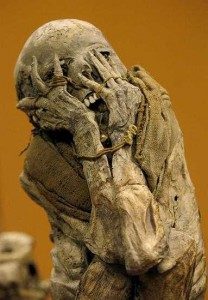
 We’re all familiar with the popular Hollywood stories of the dashing American hero, run amuck of the French Foreign Legion in Egypt, and faced with a mercenary charter from a beautiful British woman. The two narrowly escape capture, only to find themselves swept up in an adventure to save the world from the evil agenda of a mummy and its followers.
As is typically the case in Hollywood, facts sometimes get muddled in the creative process, and what we’ve come to know of the legend of the Book of the Dead, may be less accurate than you think.
It is true that ancient Egyptians made use of a document, now known as ‘The Book of the Dead’, though it is far less dubious than the name suggests. The name of the book, coined by German Egyptologist Karl Richard Lepsius, was an unfortunate failure of translation from ancient Egyptian, to Arabic, to German and then to English. Something was definitely lost in that translation.
What archaeology knows as the Book of the Dead was long believed to be the Egyptian Bible, though that belief was replaced with the understanding that the text contains more ritualistic hymns, prayers and incantations, than it does religious doctrine, and was intended to aid the deceased in passing through obstructions in the afterlife (basically a how-to manual for surviving in the hereafter). It was commonly placed inside the inside the coffin or burial chamber, along with the many other items of spiritual power and wealth.
So, if the Book of the Dead was simply a set of post funeral instructions, where did the mummy legend come from? This point is up for debate, though some theories have been postulated.
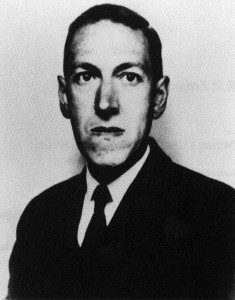 The famed American horror author H.P. Lovecraft (August 20, 1890 – March 15, 1937) may be to blame for more that just a few nightmares.
Lovecraft was, in his own time, a little known and under appreciated author of cult stories and strange horror fiction. His tastes were not aligned with the temperament of his audience at the time, though his work has gained world renown since his death. Author/Film Maker Stephen King attributes his own sick sense of gore and suspense to Lovecraft (among others).
There is a wide belief that Lovecraft’s most famous work, ‘Cthulhu Mythos’, which has garnered the most attention and influenced more writers worldwide than any other, may actually be a partial plagiarism from the infamous Arabic tome, the Necronomicon.
According to some experts in the study of ancient texts, namely Justin Geoffry in his book ‘The Book of the Arab’, The Necronomicon is shrouded in its own mysteries and misunderstandings. History had largely accounted the Necronomicon as a collection of evil, as a grimoire or sorcerers handbook, but as is often the case with such fantastic claims, scholars have discovered something very different.
Study of the ancient languages has lead scholars to the correct translation of the books title: ‘Book of Dead Names’. The Necronomicon was originally written in Damascus in 730ad, by a man who is described by some as a wandering mad poet, Abdul Alhazred. Little is known about Alhazred, but much speculation has taken place and many believe that he was a well read nomad born of the Yemen province of Sanaa.
What is known is that the Necronomicon was an incoherent literary rambling of a man who has been compared to Madam Blavatsky, famed author of ‘The Secret Doctrine’. It is believed that the actual purpose of the book was an historical accounting of traditions, languages and important people who had passed on, though Alhazred was less talented as a writer, than he was as a historian.
As a result of his tendency to spin in tangent mid sentence and to marry odd concepts together with little logic or meaning, superstitious readers of the book became convinced that the book itself held supernatural powers, bestowed upon it by the raving madman.
So where does Lovecraft fit into all this?
Well, poet and magician Aleister Crowley is known to have studied various copies of the actual Necronomicon texts (of which there are variations due to banning, destruction and selective editing) as a part of research for his own ‘Book of the Law’, and as it turns out, Crowley’s love interest and later wife, Sonia Greene, was an influential acquaintance of Lovecraft, and had both opportunity and cause to share her suitors work and ideas with the weirdly charismatic horror author.
This is all well and good, and provides some food for thought, but there’s still no connection between the modern mummy legends and Lovecraft, let alone the Necronomicon.
The leap from Lovecraft to modern Hollywood is no real stretch; after all, so many writers and directors are vociferous in their love of Lovecraft. It’s not hard to see how the fundamentals of the ‘Cthulhu Mythos’ leeched its way into popular culture. The one piece of evidence that is compelling in all this is the fact that no other book or script in the history of mankind has been so vehemently regarded as an ancient grimoire for raising and controlling the dead. The Necronomicon is such a book, and the superstition surrounding this script is virtually identical in foundation to the very adventures our hero and his heroine face on the silver screen.
Believe what you may, but know that behind every great adventure story is a grain of truth, though that truth may come from somewhere completely surprising.